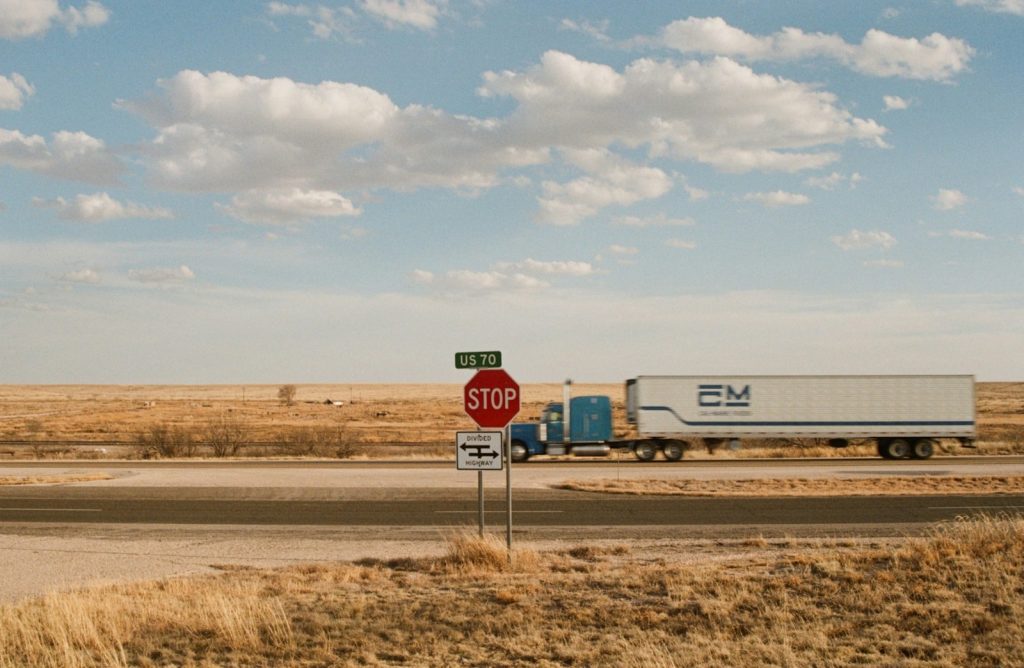
New Mexico Trucking Accident Lawyer
When a Commercial Truck Destroys Your Life in Seconds, You Need Fearless Advocacy — and a Lawyer Who Knows How to Fight Trucking Companies and Take Them to Trial.
A collision with a semi-truck, 18-wheeler, or commercial vehicle is not a car accident. It is a catastrophic event — and it triggers an immediate, well-funded corporate response designed to minimize what you receive. Before you’ve left the hospital, the trucking company’s insurance team and accident investigators are already at the scene, preserving evidence that helps them and destroying evidence that helps you.
Alex Flores at Singleton Schreiber brings fearless advocacy and 13+ years of complex litigation experience to the representation of seriously injured New Mexicans and the families of those killed in trucking accidents across the state. With the full resources of a national firm behind him and deep roots in the New Mexico legal community, he knows how to level the playing field — and how to hold trucking companies fully accountable for the destruction they cause.
No fee unless we win — case costs are advanced and reimbursed from the recovery. We return every call.
Who can be held liable in a New Mexico truck accident?
A New Mexico truck accident often involves several liable parties — the driver, the trucking company, the broker, and cargo or maintenance contractors. Federal FMCSA rules require interstate trucks to carry at least $750,000 in liability coverage, and many carry far more. You generally have three years to file.
13+ Years
Complex Litigation
Singleton Schreiber
National Firm
No Fee
Unless You Win
Free Consultation
Return Call Guaranteed
Why a Trucking Accident Case Is Fundamentally Different From a Car Accident
Trucking accidents are among the most legally complex personal injury cases in existence. If you’ve been seriously injured, here’s why it matters that you choose a lawyer who handles these cases specifically:
Multiple layers of liability. Unlike a two-car collision, a trucking crash may involve the truck driver, the trucking company, the trailer owner, the cargo shipper or broker, the maintenance contractor, and the truck or parts manufacturer — each with separate insurance policies totaling millions of dollars in potential coverage.
Federal regulation governs everything. Commercial trucking is subject to the Federal Motor Carrier Safety Administration (FMCSA) and a dense body of federal regulations — from driver qualification standards to hours-of-service limits to mandatory inspection logs. Violations of these regulations are powerful evidence of negligence. But you have to know where to look and what to ask for.
Evidence vanishes within days. The electronic data recorder (black box) in a commercial truck captures speed, braking, and steering data in the moments before impact. Electronic logging device (ELD) records show whether the driver exceeded legal drive-time limits. Driver qualification files, drug test results, and maintenance records are all fair game — but materials no rule covers — like dashcam video — can be discarded at any time if no preservation demand is made, and even federally required records must be kept for only three to six months.
The defense mobilizes immediately. Large trucking companies retain specialized defense firms and accident reconstruction experts on retainer. Their team is on the scene within hours. You deserve the same urgency on your side.
Where the crash happened shapes the case. I keep separate pages for truck crashes in Rio Rancho and Sandoval County, Farmington and the San Juan Basin, Hobbs and Lea County, and Santa Fe and the I-25 corridor, each covering the local courts, hospitals and carriers.
The First 72 Hours: Evidence That Disappears
The most critical window in any trucking accident case is immediately after the crash. Here is what needs to happen — and what experienced trucking companies are already doing on their side.
What the trucking company does: Within hours of a serious accident, most major carriers dispatch an accident response team to the scene. They photograph from their perspective, interview witnesses, inspect the truck, and begin building a narrative that minimizes their exposure.
What your attorney must do immediately after being retained:
- Send a spoliation letter demanding preservation of all electronic data — EDR/black box, ELD logs, GPS tracking records, and dashcam footage
- Preserve the driver’s hours-of-service logs and driver qualification file (DQF) — documenting driving history, training records, drug test results, and medical certifications
- Request the truck’s driver vehicle inspection reports (DVIRs) and maintenance records for the prior 12 months
- Obtain dispatch records and communication logs showing what the driver was instructed to do before the crash
- Arrange for independent accident reconstruction to document scene evidence before it degrades
- Subpoena IFTA fuel records to reconstruct the driver’s actual route and hours
Dashcam footage is typically overwritten in 24–72 hours unless preserved. Skid marks fade. Witnesses move on. The sooner an attorney acts, the stronger your case.
Who Can Be Held Responsible for a Trucking Accident in New Mexico?
One of the most important advantages in a trucking case is that liability can extend far beyond the driver. New Mexico follows a pure comparative fault standard, meaning every responsible party can be held accountable for their share — and their insurance coverage stacks accordingly.
The Truck Driver
Driver error causes the majority of trucking crashes: fatigue (beyond legal hours-of-service limits), distracted driving, impaired driving, speeding, and failure to perform required pre-trip inspections. On New Mexico’s long isolated stretches of I-40 and US-285, drowsy driving is a constant hazard.
The Trucking Company
Under New Mexico respondeat-superior law — reinforced by federal leasing rules, 49 CFR § 376.12 — a motor carrier is vicariously liable for its drivers’ negligent acts. Beyond vicarious liability, the company may be independently negligent for hiring unqualified drivers, inadequate training, and pressuring drivers to violate hours-of-service limits.
The Trailer Owner
In modern trucking, the tractor and trailer are often owned by different entities. If the trailer had defective brakes, a faulty rear underride guard, or other equipment failures, the trailer owner bears independent liability.
The Cargo Shipper or Freight Broker
Improperly loaded or secured cargo causes jackknifes, rollovers, and load-spill crashes. Federal regulations place strict requirements on shippers and brokers for securing loads.
The Maintenance Contractor
If a brake failure, tire blowout, or mechanical defect caused the crash, the maintenance contractor may share liability.
The Truck or Parts Manufacturer
Defective brakes, faulty steering, or inadequate safety equipment can expose the manufacturer to product liability.
Federal minimum insurance for commercial trucks carrying general freight is $750,000. Trucks carrying hazardous materials must carry up to $5 million. When multiple liable parties are involved, total available insurance can reach into the tens of millions.
Trucking Accidents in New Mexico: The Scale of the Problem
New Mexico’s highway system makes it one of the most heavily traveled freight corridors in the western United States — and one of the most dangerous for motorists sharing the road with commercial trucks.
That disproportionate fatality rate tells the story: when a loaded commercial truck collides with a passenger vehicle, the results are rarely minor.
New Mexico’s highest-risk corridors:
- Interstate 40 — The main east-west freight artery through Albuquerque, Grants, Gallup, and Tucumcari. Enormous volumes of cross-country freight traffic.
- Interstate 25 — North-south spine through Albuquerque, Santa Fe, and Los Lunas. Heavy truck traffic year-round.
- US-285 / Permian Basin Corridor — Carlsbad, Hobbs, Artesia, and Roswell carry extreme tanker and oilfield truck traffic 24 hours a day.
- US-550 — Connects Albuquerque and Rio Rancho to the San Juan Basin energy fields near Farmington.
- Interstate 10 — Southern NM’s east-west freight corridor through Las Cruces and Deming.
- US-491 — Four Corners freight route through Gallup into the Navajo Nation.
What Causes Trucking Accidents in New Mexico?
Most trucking accidents are not true “accidents” — they are the predictable result of decisions by drivers, companies, and regulators who cut corners on safety.
Hours-of-Service (HOS) Violations (49 CFR § 395.3)
Federal law limits commercial drivers to 11 hours of driving within a 14-hour on-duty window. On the long isolated runs common in New Mexico — Carlsbad to Albuquerque, Hobbs to Albuquerque, Tucumcari to El Paso — fatigued driving is a constant hazard. ELD data and fuel records can expose HOS violations the paper logbook conceals.
Distracted and Impaired Driving
Federal regulations prohibit commercial drivers from texting or using hand-held devices while driving. Commercial drivers are also held to a lower BAC limit (0.04%) and subject to random drug and alcohol testing. Violations are serious and frequently reveal patterns the company failed to address.
Inadequate Pre-Trip Inspections (49 CFR §§ 392.7, 396.13)
FMCSA regulations require drivers to complete a written pre-trip inspection before every run. Brake failures — the leading equipment cause of fatal truck crashes — are frequently traceable to skipped or falsified inspection reports.
Improper Cargo Loading
Overloaded trucks, improperly secured flatbed loads, and poorly balanced tanker shipments cause rollovers, jackknifes, and load-spill crashes. This is a particular problem in the oil field corridors of southeastern New Mexico where loads are assembled quickly under production pressure.
Driver Qualification Failures (49 CFR § 391)
When companies put drivers with prior DUIs, accident histories, or invalid CDLs on the road, the company bears direct liability. A thorough investigation of the driver qualification file frequently reveals exactly what the carrier knew — and chose to ignore.
Mechanical Failures and Deferred Maintenance (49 CFR § 396)
Brake system failures, tire blowouts, and steering failures all contribute to trucking crashes. Deferred maintenance on older fleet vehicles is a pattern that thorough investigation frequently reveals.
Injuries in Trucking Accidents Are Often Life-Changing
The sheer mass and momentum of a loaded commercial truck — up to 80,000 pounds (40 tons) — means collisions with passenger vehicles produce injuries unlike those in other motor vehicle accidents.
Traumatic Brain Injury (TBI)
TBI is the leading cause of disability following motor vehicle accidents. In trucking crashes, the violent forces involved can cause diffuse axonal injury, skull fractures, and permanent cognitive impairment. A “mild” TBI can produce chronic headaches, memory problems, personality changes, and inability to work.
Spinal Cord Injuries and Paralysis
Cervical spine injuries from high-force collisions can result in partial or complete paralysis. The lifetime care costs for a spinal cord injury victim routinely exceed $1 million to $5 million — which is why comprehensive investigation into all liable parties and all available insurance is critical.
Amputations and Crush Injuries
The weight of a commercial truck, particularly in underride crashes where the smaller vehicle passes beneath the trailer, can cause catastrophic crush injuries requiring amputation.
Severe Burns
Fuel tank ruptures cause fires that produce severe burns requiring multiple surgeries, skin grafting, and years of reconstructive care.
Wrongful Death
New Mexico’s Wrongful Death Act allows survivors to pursue claims for economic losses, non-economic damages, and in cases of egregious conduct, punitive damages. The statute of limitations is three years from the date of death.
What Compensation Can You Recover After a New Mexico Trucking Accident?
New Mexico law allows trucking accident victims to recover three categories of damages:
Economic Damages — The tangible financial losses:
Medical expenses (past and future), lost wages and lost earning capacity, cost of household services, vehicle replacement, and all out-of-pocket expenses related to the accident and recovery.
Non-Economic Damages — The human cost:
Physical pain and suffering (past and future), emotional distress, loss of enjoyment of life, permanent disfigurement or disability, and loss of consortium.
Punitive Damages — When conduct was egregious:
Under New Mexico law, punitive damages are available when a defendant’s conduct was willful, wanton, reckless, or fraudulent. Falsification of logbooks, knowingly operating a vehicle with defective brakes, or placing a driver with a known substance abuse problem on the road can all support a punitive damages claim. Punitive damages are not subject to a general cap in New Mexico personal injury cases, though specific limits apply in medical-malpractice and dram-shop claims and against government defendants.
The value of a trucking accident claim depends on the severity of injuries, the number of liable parties, available insurance coverage, and the quality of the investigation. The sooner an experienced attorney begins work, the stronger the case for full compensation.
How Alex Flores Builds a Trucking Accident Case
Most personal injury lawyers handle car accidents. Trucking cases require a different level of investigation, industry knowledge, and resources. Here is what Alex Flores — backed by the national team at Singleton Schreiber — brings to your case.
Immediate Preservation Demand
Immediately after being retained, Alex sends a spoliation letter to every potentially liable party — the driver, the carrier, the trailer owner, the shipper — demanding preservation of all electronic data, driver records, maintenance logs, dispatch communications, and surveillance footage. If evidence is destroyed after the demand, the court can instruct the jury to draw an adverse inference.
Electronic Data Recovery
Black box/EDR data captures vehicle speed, throttle, and braking force in the seconds before impact. ELD records provide a complete picture of the driver’s hours. GPS tracking shows the truck’s route and any stops. This data must be downloaded by a qualified expert before it is overwritten.
FMCSA Compliance Investigation
Alex obtains the carrier’s FMCSA safety rating, inspection history, out-of-service violations, and prior crash record. A carrier with a history of HOS violations and maintenance deficiencies is a carrier that knew about its safety problems and chose to ignore them — which goes directly to punitive damages.
Expert Witnesses
Depending on the facts, Alex works with accident reconstruction specialists, FMCSA compliance experts, life care planners, vocational rehabilitation specialists, and economists to fully quantify damages and establish liability.
Fearless Advocacy — Negotiation and Trial When Necessary
Most trucking cases settle before trial — but the ones that settle for maximum value do so because the opposing side knows the plaintiff’s lawyer is prepared to go to trial. Singleton Schreiber is a trial firm built on fearless advocacy. When carriers and their insurers refuse to pay fair value, Alex takes cases to a New Mexico jury.
New Mexico Trucking Accident Laws: What You Need to Know
Statute of Limitations
In New Mexico, you have three years from the date of the trucking accident to file a personal injury lawsuit (NMSA § 37-1-8). Wrongful death claims carry the same three-year limit from the date of death. Missing this deadline bars your claim permanently — regardless of how strong your case is.
Do not wait three years. Critical evidence disappears in days or weeks. The strongest cases are built by attorneys who get involved immediately.
New Mexico Pure Comparative Fault
New Mexico follows a pure comparative fault rule. Even if you were partially at fault for the crash, you can still recover — your recovery is simply reduced by your percentage of fault. A defendant who claims you were partially responsible will not eliminate your case.
Insurance Requirements and Coverage
Commercial trucks are required under federal law to carry minimum insurance of $750,000 for general freight. Your own uninsured/underinsured motorist coverage may provide an additional layer of protection in some circumstances. Alex reviews all available coverage sources as part of every case.
Federal Jurisdiction
Because commercial trucking is federally regulated, many aspects of these cases involve federal law, federal administrative records, and federal evidence standards. Alex’s work with Singleton Schreiber gives him access to attorneys with deep federal practice experience.
Common Types of New Mexico Truck Crashes
The physics of an 80,000-pound tractor-trailer produce crash patterns you rarely see in passenger-car collisions:
- Jackknife. The trailer swings out of line with the cab — from hard braking, speed in a curve, or ice on I-25 and I-40 — sweeping across multiple lanes.
- Underride and override. A smaller vehicle slides beneath the trailer, or the truck rides up over a stopped car. Among the deadliest crashes on the road.
- Rollover. Top-heavy or improperly loaded trailers roll on ramps and curves — a recurring problem with quickly assembled oilfield loads in the southeast.
- Rear-end. A loaded semi needs far more stopping distance than a car; in stop-and-go and work-zone traffic a momentary lapse becomes a high-mass collision.
- Blind-spot ("no-zone") crashes. Trucks have large blind spots on all four sides, and lane changes catch cars the driver never saw.
- Tire blowouts and cargo spills. Failed retreads and unsecured loads turn a single-vehicle event into a multi-car pileup at highway speed.
When the Truck Is Federally Operated
If the commercial vehicle that hurt you was operated by the federal government or a federal contractor on duty — a U.S. Postal Service truck, a military or BIA fleet vehicle, or a federal contractor — the claim runs under the Federal Tort Claims Act, not ordinary state procedure. The FTCA requires an administrative claim within two years, and the process differs from a claim against a private carrier. These deadlines are strict and easy to miss. See my New Mexico FTCA page and act quickly.
Frequently Asked Questions: New Mexico Trucking Accidents
Call 911 and get medical attention — even if you feel fine. Adrenaline masks pain, and serious injuries like TBI and internal bleeding are not always immediately apparent. If you are physically able, photograph the vehicles, road conditions, and the truck’s DOT number and carrier name. Collect witness contact information. Do not give a recorded statement to the trucking company’s insurance adjuster without first speaking to an attorney — their job is to minimize your claim.
New Mexico’s statute of limitations for personal injury is three years from the date of the accident (NMSA § 37-1-8). Wrongful death actions must be filed within three years of the date of death. While three years may sound like a long time, dashcam footage, black box data, and witness recollections begin disappearing within days. Contact an attorney as soon as possible.
Trucking accidents differ in several critical ways. Federal law governs commercial trucking through the FMCSA, creating requirements (hours of service, driver qualifications, vehicle maintenance, cargo loading) that don’t apply to ordinary drivers. Multiple parties may be liable — driver, carrier, trailer owner, shipper, maintenance contractor. Available insurance is substantially higher (federal minimum $750,000). And evidence specific to trucking — black box data, ELD logs, driver qualification files — requires immediate action to preserve.
Potentially liable parties include: the truck driver; the trucking company (both vicariously and for its own negligence in hiring, training, and supervision); the trailer owner; the cargo shipper or freight broker; the maintenance contractor; and the truck or parts manufacturer. Each party may carry separate insurance, and total coverage in serious trucking cases can reach into the tens of millions of dollars.
Case value depends on the nature and severity of your injuries, your medical expenses and lost income, the long-term impact on your life and family, the number and insurance coverage of the liable parties, and whether the conduct supports punitive damages. There is no formula that applies to every case. What Alex can tell you in a free consultation is what information is needed to assess value, what evidence matters most, and what strategy makes sense given the specific facts.
Yes — and often the company is where the larger recovery lies. Under respondeat superior, a trucking company is liable for its employees’ negligent acts within the scope of employment. Beyond that, the company may be independently liable for negligent hiring, training, supervision, or maintenance. The contractor label does not automatically shield a carrier from liability.
New Mexico’s Wrongful Death Act allows the personal representative of the estate to bring a wrongful death claim for the benefit of surviving family members. Recoverable damages include the economic value of the decedent’s lost earnings, compensation for pain and suffering before death, and in appropriate cases, punitive damages. The statute of limitations is three years from the date of death.
Alex handles trucking accident cases on a pure contingency fee basis: you pay no attorney fees unless and until a recovery is made. The fee is a percentage of the recovery, agreed upon at the outset. There is no retainer, no upfront payment, and no fee if there is no recovery. Case expenses are handled as part of the contingency arrangement. Everything is spelled out clearly in the written fee agreement before any work begins.
Alex Flores brings together what most trucking accident victims need most: deep New Mexico roots — he knows the courts, the judges, and the local landscape of these cases — combined with the resources of a national firm (Singleton Schreiber’s network of experts, investigators, and co-counsel in trucking cases nationwide). He handles serious cases, not volume, and delivers the fearless advocacy that complex trucking litigation demands. When you work with Alex, you work directly with the attorney who will take your case to verdict if necessary.
No. The initial consultation is completely free and there is no obligation. A return call is guaranteed. Alex will review the facts, explain your options, and tell you honestly whether you have a case worth pursuing — and if so, what steps need to be taken immediately to preserve evidence. Call today or submit your case details online.
Talk to a New Mexico Trucking Accident Lawyer — Free Consultation
If you or someone you love has been seriously injured or killed in a trucking accident anywhere in New Mexico, every day that passes is a day of potential evidence loss. Alex Flores at Singleton Schreiber offers a completely free, no-obligation consultation. You’ll speak directly with Alex — not a receptionist, not a case manager. A return call is guaranteed.
Fearless advocacy for seriously injured New Mexicans — backed by the full resources of Singleton Schreiber. There is no fee unless you win. Case costs are advanced by the firm and reimbursed from the recovery.
Representing clients across New Mexico — Albuquerque, Santa Fe, Rio Rancho, Las Cruces, Roswell, Hobbs, Alamogordo, Los Lunas, Taos, Farmington, Carlsbad, Gallup, Clovis, Silver City, Portales, and all communities statewide.
Looking for something else? All NM Practice Areas | About Alex Flores | Free Case Review